Office: HGH 210; phone: (408) 924-5378
Email: wooda@email.sjsu.edu
Web: http://www.sjsu.edu/faculty/wooda
|
Dr. Andrew Wood Office: HGH 210; phone: (408) 924-5378 Email: wooda@email.sjsu.edu Web: http://www.sjsu.edu/faculty/wooda |
Reading:
McCloud, S. (1993). Understanding comics: The invisible art. New York: HarperCollins.
| Note: These comments are not designed to "summarize" the reading. Rather, they are available to highlight key ideas that will emerge in our classroom discussion. As always, it's best to read the original text to gain full value from the course. |
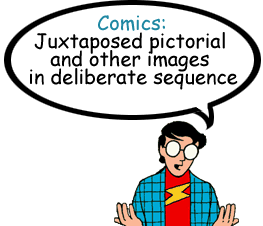
Scott McCloud defines comics as "Juxtaposed pictorial and other images in deliberate sequence." This definition imagines two or more two-dimensional objects ordered for a certain purpose. This definition may be compared to single images or cartoons, or even film which is generally experienced as a single two-dimensional object which changes through time. McCloud adds the notion that comics serve a specific purpose (eg., to convey information and/or to produce an aesthetic response). However, for now, let's stick with the form, leaving the function of comics to their creators and consumers.
Even though comics represent an ancient art form, they have often been considered examples of "low culture." Examples of comic art have been found in Egyptian paintings and Japanese scrolls in which a series of images were ordered to craft a message for some purpose. Of course, the popular conception of comics limits them to pulpy examples of throw-away culture. One might explain this phenomenon by the fact that the introduction of printing could not adequately reproduce iconic images as well as more easily copied symbols: words. Thus, the world of quality visual images remained cloistered among the very wealthy who could acquire them while the world of text because accessible to most peoples and lost much of its perceived value in the process. Even so, the advent of mass reproduction of "quality" images has rendered the distinction between high and low culture less valid than it appeared to be a century ago.
[Return]