• Research
Buy Amazon • Hampton Press
• Research |
||
Buy Amazon • Hampton Press |
||
Research and Secondary References |
Excerpts
of Wood's omnitopia research |
|||||

|
 |
 |
 |
 |
|
| Communication
Theory 13(3) This
essay proposes three
central aspects of omnitopia: generic environments, continual movement,
and atomized interactions. In so doing, the article extends upon previous
inquiries into utopia and heterotopia while commenting upon the changes
to terminal life wrought by the September 11, 2001, terrorist attacks.
|
Critical
Studies in Media Communication 22(3) This
essay (co-authored with my SJSU colleague, Anne Marie Todd) demonstrates
how The Simpsons depicts urban life as a mutable environment
whose disparate locales convey their inhabitants to a version of public
life marked by dislocation, conflation, fragmentation, mutability, mobility,
and commodification. |
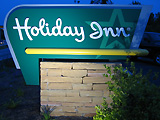
Space and
Culture 8(4) This
essay explores the role of motels in the transition between idiosyncratic
locales to homogenized chains. This analysis of early-twentieth-century
motels reveals three practices: dislocation through vernacular architecture,
fragmentation through iconic signage, and mutability through roadside
simulacra. |
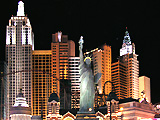
Text and Performance
Quarterly 25(4) This
essay explores Las Vegas as a stage-set for tourist performance, concentrating
on two foci: (1) Las Vegas as omnitopia and (2) the performance of Las
Vegas through post-tourism. The essay also discusses the consequences
of inauthentic post-tourist play as imagined by critics of "mere
pleasure." |
Sith,
Slayers, Stargates, + Cyborgs (edited volume) This
chapter from David Whitt and John Perlich's book on modern myth offers
an updated introduction to the omnitopian framework. I invite you to examine
their complete collection
of essays. Note: This scan from a photocopy is less-than ideal; some
of the pages are a bit crooked. The book is perfectly aligned. |
|
| See
also: Wood, A. (2010). Two roads diverge: Route 66, "Route 66,"
and the mediation of American ruin. Critical Studies in Media Communication, 27(1), 60-76. |
|||||
Some Appearances of omnitopia in other scholarship Adey, P. (2007). "May I have your attention": Airport geographies of spectatorship, position, and (im)mobility. Environment and Planning D: Society and Space, 25(3), 515-536. Adey, P., Budd, L., Hubbard, P. (2007). Flying lessons: Exploring the social and cultural geographies of global air travel. Progress in Human Geography, 31(6), 773-791. Barnett, R.S. (2005). A space for agency: Rhetorical agency, spatiality, and the production of relations in supermodernity. Unpublished masters thesis, North Carolina State University, USA. Devereux, E. (2007). Understanding the media (2nd ed). Thousand Oaks: Sage. Hartmann, M. (2009). The changing urban landscapes of media consumption and production. European Journal of Communication, 24(4), 421-436. Irving, B.A. (2009). The rhetorical dimensions of place-making: Texts, structures, and movement in Atlantic Station. Unpublished master's thesis. Georgia State University, USA. Kachornnamsong, K. (2006, May). ISY: Enhancing positive user experience in transit area. Mads Clausen Institute for Product Innovation, University of Southern Denmark. Kellerman, A. (2008). International airports: Passengers in an environment of 'authorities'. Mobilities, 3(1), 161-178. Kitchin, R. & Dodge, M. (2009). Airport code/spaces. In S. Cwerner, S. Kesselring, & J. Urry (Eds.), Aeromobilities (pp. 96-114). Abingdon: Routledge. Kofoed, E.S. (2009). The discursive representations of borderlands: An analysis of visual culture and conceptions of place occurring at the U.S.-Mexico border. Unpublished master's thesis. Kansas State University, USA. McAlister, J.A. (2009). Material aesthetics in Middle America: Simone Weil, the problem of roots, and the pantopic suburb. In B.A. Biesecker & J.L. Lucaites (Eds.). Rhetoric, materiality, and politics (pp. 99-130). New York: Peter Lang. McRae, J.D. (2008). Play City life: Henri Lefebvre, urban exploration and re-imagined possibilities for urban life. Unpublished masters thesis, Queen's University, Kingston, Ontario, Canada. O'Grady, B. (2010). Because I know you don't read the newspaper: A rhetorical analysis of the Boondocks animated series. Unpublished master's thesis. Texas Tech University, USA. Pepe, A. (2009). Reinventing airspace: Spectatorship, fluidity, intimacy at PEK T3. ACE: Journal of Architecture, City & Environment, 4(10), 9-19. Salter, M.B. (2007). Governmentalities of an airport: Heterotopia and confession. International Political Sociology, 1(1), 49-66. Sarabu, C.R. (2009). Anthroportscapes. Unpublished honors thesis, Cornell University, USA. Sharma, S. (2009). Baring life and lifestyle in the non-place. Cultural Studies, 23(1), 129-148. Stewart, J. & Dickinson, G. (2008). Enunciating locality in the postmodern suburb: FlatIron Crossing and the Colorado lifestyle. Western Journal of Communication, 72(3), 280-307. Stewart, J. (2007). The rhetoric of South Park. Unpublished Masters thesis, University of Cincinnati, USA. Scott, D.G (2006). Socialising the stranger: Hospitality as a relational reality. Unpublished masters thesis, University of Otago, Dunedin, New Zealand.
Appearances of omnitopia in the popular press Cassidy, M. (2009, February 27). Can we talk? Well, yes, but why bother? San Jose Mercury News, E1, E5. Reprinted in Seattle Times (March 16): http://seattletimes.nwsource.com/html/books/2008865217_btview16.html Cicco, N. (2010, July 14). York should leave formula restaurant ban as it is. York Weekly. Online: http://www.seacoastonline.com/apps/pbcs.dll/article?AID=/20100714/OPINION/7140324/-1/NEWSMAP Nelson, A. (2002, April 29). The Holiday Inn sign. Salon. Online: http://archive.salon.com/ent/masterpiece/2002/04/29/holiday_inn/print.html Pappas, S. (2009, February 5). SJSU professor looks to burst the bubble of omnitopia with new book. Santa Cruz Sentinel, B3. Plotnikoff, D. (2001, February 16). The wired world as a metaphor for life online and offline. San Jose Mercury News, 3C. Vorderbrueggen, L. & Cuff, D. (2006, July 6). Rudeness breeds not-so-happy campers: Getting away from it all almost a thing of the past as trips marred by loud music, inconsiderate neighbors. Contra Costa Times, unknown page.
Do you know
of other published uses of the omnitopia framework? |
|||||
This page is also accessible via tinyurl.com/omniresearch © 2010 |
|||||