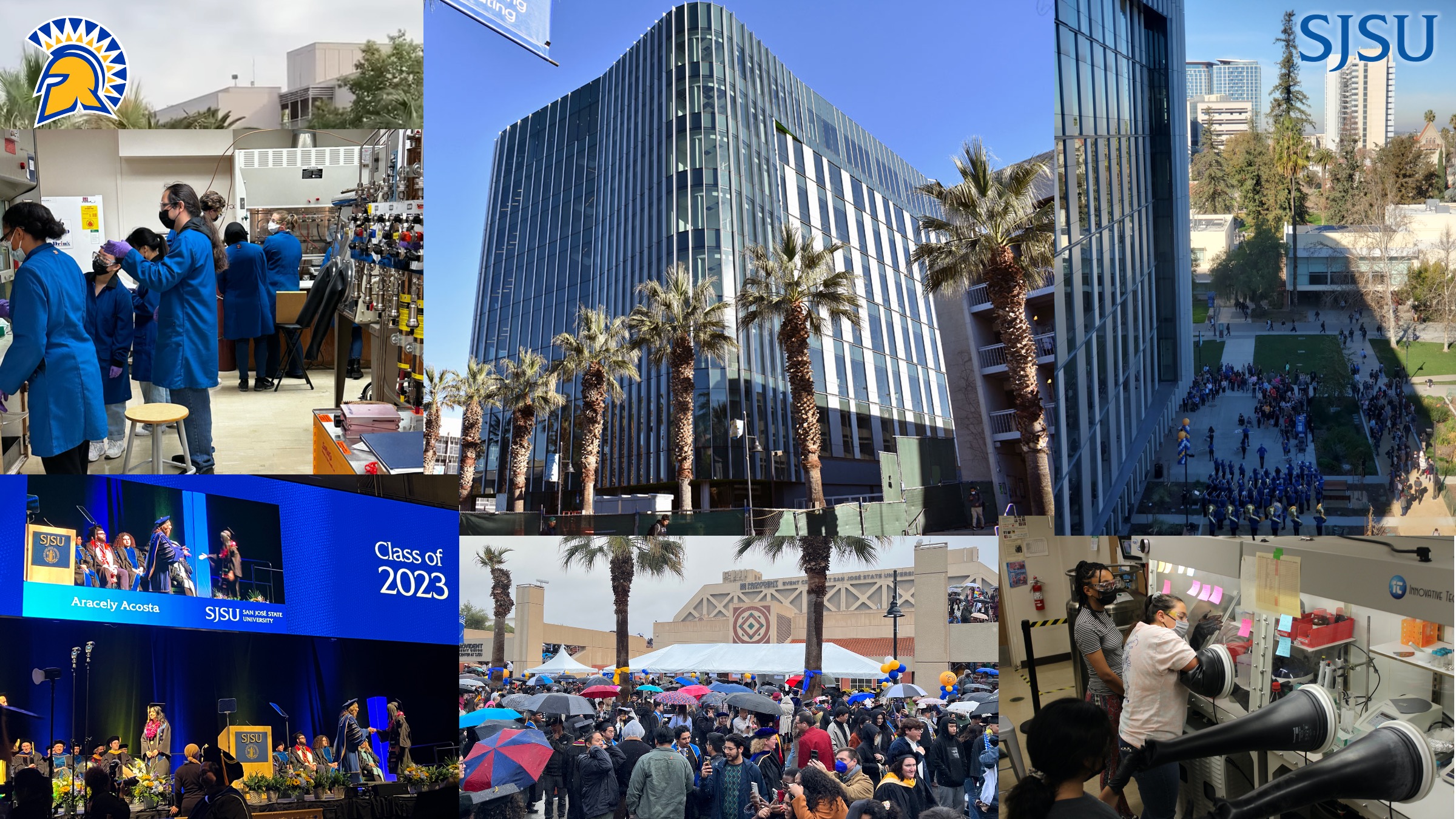
Welcome to the SJSU Chemistry Department

Bradley Stone, Chair
Our department strives to provide broad access to the highest quality education in chemistry at the undergraduate and masters degree levels. Read more about our department, facilities, and career opportunities in chemistry at: About the SJSU Chemistry Department.
Light-Powered Artificial Enzyme Prepared
Global climate change and the current economic crisis have stimulated interest in developing technologies utilizing renewable energy, such as sunlight, to avoid the dependence on fossil fuels. In a striking development in this area, Professor Cheruzel's research group has developed a semisynthetic light-powered redox enzyme. The first generation of these enzymes are hybrids containing a photosensitizer covalently attached to a cytochrome P450 BM3 heme domain enzyme. Upon light activation, these hybrid enzymes catalyze the selective hydroxylation of long chain fatty acids. A preliminary account of their achievement has been published recently in a paper in Chemical Communications. Cheruzel and his coworkers are now engaged in preparing the second generation of hybrid enzymes with improved catalytic activity and substrate recognition.
Understanding Student Misconceptions
Students studying general chemistry often develop misconceptions about the molecular details of the processes that they study. How can teachers prevent, or at least reduce these? In a recent paper published in the Journal of Chemical Education, Prof. Resa Kelly and her group begin to answer this question. In an NSF-funded study, Kelly's team examined student misconceptions about simple aqueous precipitation reactions by asking students to depict in drawings the molecular details of symbolic chemical equations. A careful analysis of the results reveals a range of misconceptions mainly dealing with misunderstanding the detailed meanings of the symbolic representations. These conclusions lead Kelly's group to make a series of recommendations for people teaching these principles.
Modifying Materials and Cells with Fluorine
It is well known that coating surfaces with fluoralkyl groups makes them both hydrophobic and lipophobic. The most well known example of this is DuPont polymer Teflon that can be used to generate an array of non-stick products from frying pans to stadium roofs. Now two research groups at SJSU have discovered that fluoroalkyl coatings can be used to significantly modify the surface properties of cells and chromatography materials. Prof. Joseph Pesek's research group recently published in Separation Science the finding that their newly prepared silica hydride-based fluorinated stationary phases have very promising retention properties for small hydrophilic analytes in aqueous normal phase HPLC. In a recent paper in the Journal of Medicinal Chemistry , Prof. Marc d'Alarcao's group, in collaboration with Prof. Krishna Kumar's group at Tufts University, report the finding that coating cell surfaces with fluorinated carbohydrates leads to reduced cell adhesion. This result may be important in the development of antimetastasis agents and diagnostic methods for cancer.
Metabolomics by Capillary Electrochromatography

A new manuscript highlights how capillary electrochromatography can be used for the analysis of metabolites. Michael Nshanian, a graduate student in Prof. Pesek's group, wrote the manuscript titled "Open tubular capillary electrochromatography of small polar molecules using etched, chemically modified capillaries" based on the results from his M.S. thesis. The methods reported have applications in biomarker discovery, in disease diagnosis, and for drug analysis. The paper, coauthored by Prof. Pesek and Dr. Maria T. Matyska, has been accepted for publication in the peer-reviewed international journal Electrophoresis.
SJSU Chemistry Students Win Prestigious Awards

For the second year in a row, a chemistry student has been named as Outstanding Graduating Senior at SJSU. Phillip Calabretta, pictured above, is the recipient of the 2012 award and Andrew Ingram, now a doctoral student at Stanford University, received this honor in 2011. SJSU President Mohammad Qayoumi will recognize Calabretta, along with mechanical engineering student Killol Acharya, at the University Commencement ceremony on May 26 in Spartan Stadium. Calabretta, who will graduate with a B.S. in Chemistry and who did research with both Prof. Daryl Eggers and Prof. Marc d’Alarcao, is being recognized for his scholarship and contributions to the community. He is planning to pursue a Ph.D. degree in Chemical Biology at the University of Wisconsin beginning in the fall. Read more about Calabretta’s achievements here.
Five current and former students that have done research in the SJSU Chemistry Department are recipients of coveted NSF Graduate Research Fellowships. Jessica Killian (BS 2010) received the Fellowship in 2010 and is currently in a Physics graduate program at Cornell University. Killian did her undergraduate research with Prof. Bradley Stone. Both Victoria Chemistruck (BS 2010) and Cardius Richardson (BS 2010) were awarded the Fellowship in 2011. Chemistruck and Richardson, now in graduate school at the University of Minnesota and UC Santa Cruz, respectively, both did research with Prof. David Brook. Thao-Nhi (Lily) Le (BS 2010) and Andrew Ingram (BS 2011) are Fellowship recipients in 2012. Le, who did research with Prof. Elaine Collins, is now in graduate school at UC Santa Cruz, while Ingram is undertaking graduate study at Stanford after doing research with Prof. Gilles Muller. Each Fellowship awardee receives a $30,000 annual stipend plus a $12,000 cost of education allowance to their graduate institution for a total of three years.
Two SJSU chemistry students have been named as 2012 CSUPERB Presidents’ Commission Scholars. Andy Dang, a third year student conducting research with Prof. Joseph Pesek and Jennifer Le, a second year student working with Prof. Daryl Eggers will each receive a $8,000 research scholarship. The Presidents’ Commission Scholarship program, in its inaugural year, is designed to support CSU students conducting biotechnology-related research in the summer.
High School Researcher in Collins Lab Wins Science Fair Awards

Eesha Kare, a student at Lynbrook High School, won four awards at the 2011 Synopsys Silicon Valley Science and Technology Championship: 1st Award, Individual Project, Chemistry Category; 3rd Place Award, ACS Santa Clara Valley Local Section; Grand Prize Alternate - Physical Sciences - Trip to State Science Fair, Santa Clara Valley Science & Engineering Fair Assn - Board of Directors Awards - High School Finalist; The Synopsys Outreach Foundation n+1 Prize. Her project “A Novel Method Using Chemically Engineered CYP101 Enzyme and Light to Hydroxylate Camphor” was initiated when Eesha was a 2010 summer intern in Prof. Collins’ lab at SJSU through the Johnson & Johnson Bridges-to-Employment Silicon Valley program. The project is in collaboration with Prof. Cheruzel at SJSU and teacher Amanda Alonzo at Lynbrook High.
Collins Receives IBM
Faculty Award

Professor Elaine Collins was named a recipient of the IBM Faculty Award. This is a worldwide competitive intended to "foster collaboration between researchers at leading universities worldwide and those in IBM research, development and service organizations; and promote courseware and curriculum innovation to stimulate growth in disciplines and geographies that are strategic to IBM". Read more at the IBM Awards page.
Silber Selected as ACS Fellow

Professor of Chemistry and Interim Associate Dean Herbert Silber has been selected as a 2010 ACS Fellow. This new ACS program recognizes members for "outstanding achievements in and contributions to Science, the Profession, and the Society". In addition to his duties as faculty member and Interim Assoc. Dean, Silber has been highly active in supporting minority student access to careers in chemistry and is the Program Director for the MARC U-STAR program at SJSU supported by the National Institutes of Health. He is also the winner of the ACS Shirley B. Radding Award to "recognize demonstrated, dedicated, unselfish leadership, service and significant contributions, over a sustained period of time, to industrial or applied chemistry and to the American Chemical Society at local, regional and national levels."
Muller Wins Dreyfus Award

Professor Gilles Muller has been awarded a prestigious Henry Dreyfus Teacher-Scholar Award. The Henry Dreyfus Teacher-Scholar Awards Program recognizes young faculty that "have demonstrated leadership in original scholarly research of outstanding quality with undergraduates and excellence and dedication in undergraduate education"
Singmaster Named
Professor of the Year

Professor Karen Singmaster was named San Jose State University Outstanding Professor. Upon announcing the award, SJSU President Don W. Kassing stated "Karen is a committed and passionate professor who gives her all to the advancement of education." Read more at the SJSU news page.
SJSU Hosts ACS Northern California Undergraduate Research Symposium
The 23rd annual American Chemical Society Northern California Undergraduate Research Symposium was held on May 14, 2011 on the SJSU campus. Many thanks to the keynote speaker, Prof. Kenneth N. Raymond from the University of California at Berkeley and to all the volunteers from the SJSU SAACS Chemistry Club and the SJSU Chemistry Department for helping to make this a very successful event.
Graduate Student Places in Statewide Competition

Graduate Student Meenakshi Goel (M.S. 2010) won 2nd place in the statewide Student Research Competition in which students from the 23 California Sate University campuses compete. Goel competed in the Physical and Mathematical Sciences division of the competition. Goel's research involves the synthesis of small carbohydrates with anticancer properties. Read her award-winning thesis here.
Does Water Structure Matter?
Yes! In a paper published in Biochemistry, Professor Daryl Eggers describes a new phenomenological model for interpreting the effects of secondary solutes on biological equilibria, including protein folding. The model is based on the idea that changes in water structure, as induced by specific boundary conditions, are important because they reflect changes in the free energy of water. Co-existing subpopulations of water are related to a desolvation energy term that, in turn, may be used to explain the thermodynamic contribution of water to any aqueous reaction. Read Prof. Eggers' paper. An interview with Prof. Eggers, entitled “A New Perspective on Water,” was featured in the Winter 2009 issue of the alumni magazine, the SJSU Washington Square. Read the interview (pdf).
Magnetic Nanomaterials from Stable Free Radicals
A verdazyl free radical is that most uncommon of species: a stable free radical. Now Prof. David Brook's laboratory, in collaboration with Prof. Gordon Yee's group at Virginia Tech, has used a novel dipyridyl verdazyl ligand to generate a nickel (II) complex. In a recent paper published in Chemical Communications, these researchers demonstrate strong ferromagnetic coupling between paramagnetic ligand and metal suggesting possible uses of such complexes as new magnetic nanostructures.
Undergraduate Student Goes to Germany for Research

Josh Young, an undergraduate chemistry major at San Jose State University, traveled to Germany recently to help analyze the properties of silica hydride by nuclear magnetic resonance spectroscopy. Silica hydride, a unique material developed by the Pesek research group, has been shown to be more adaptable to the chromatographic analysis of samples ranging from simple organic compounds to large biological molecules than currently available commercial materials which are based on ordinary silica. Analysis of complex mixtures is essential for such fields as disease diagnosis, drug development, forensics, food safety and environmental monitoring. The new separation material, developed at San Jose State University, provides major benefits in all of these critical areas. In Germany, Young studied the material by nuclear magnetic resonance in collaboration with Professor Klaus Albert at the University of Tübingen. Practical applications of silica hydride are being developed by laboratories across the country and around the world.