AEPG: History, Impact & Future
For nearly a decade, the Artistic Excellence Programming Grants have supported faculty- and staff-developed programming across the College of Humanities & the Arts. What began as a funding program for artistic, humanities, and educational events has gradually become a structure for connecting public programming with student learning, interdisciplinary work, and engagement beyond individual departments. The history of AEPG traces that development: from an annual grant competition to one of the foundations for the College’s broader H&A in Action ecosystem.
The Beginning: Fall 2017
The Artistic Excellence Programming Grants began in Fall 2017, when the College of Humanities & the Arts received $150,000 in base Instructionally Related Activities funding to support programming across the arts, humanities, and letters. The funding was intended to enrich students’ classroom and educational experiences through activities such as master classes, lectures, professional residencies, exhibitions, literary readings, theatrical and musical performances, and film productions.
From the beginning, AEPG was structured as a competitive College-wide program. Faculty and staff proposed projects for the following academic year, and an Awards Committee evaluated those proposals with particular attention to their educational value and their impact on students.
This structure created a shared pool of resources through which departments could develop programming that might otherwise have remained beyond the reach of ordinary instructional or departmental budgets.
The range of projects also established an important premise for AEPG: artistic and intellectual programming could become part of students’ educational experience rather than remain separate from it. A visiting artist could work directly with a class before a public performance; a theatrical production could become the subject of coursework in another discipline; a lecture could develop into a workshop, conversation, or community partnership. Over time, those connections between programming, curriculum, and participation would become increasingly central to how AEPG defined the quality and impact of the projects it supported.
From AEPG to H&A in Action
As AEPG developed, the relationships created through individual projects began to reveal possibilities that extended across the College. Faculty were bringing students into performances, exhibitions, lectures, workshops, and residencies; courses in different disciplines were engaging with the same programming; and projects were creating connections with cultural organizations and communities throughout San José. These activities provided the groundwork for a broader approach to public programming in the College.
Some of that potential was visible in the program’s earliest years. It’s Alive! Frankenstein Turns 200 brought the humanities into conversation with science and technology around the bicentennial of Mary Shelley’s novel, demonstrating how a shared cultural work could become the center of interdisciplinary teaching and public programming.
In 2021, AEPG became one of the central programs organized under H&A in Action, the College’s framework for connecting curriculum, research and creative activity, public programming, and community engagement. H&A in Action brought these activities into a shared infrastructure organized around several interconnected goals: integrating public programming with classroom learning, creating interdisciplinary curricular communities, extending the College’s work into San José and the larger South Bay, and creating opportunities for students and community participants to contribute to the production of knowledge.
The Stories of Engagement archive records how those goals began to take different forms across the College. In The Meaning of Linguistic Diversity, students in Linguistics and TESOL conducted interviews exploring language, dialect, accent, equity, inclusion, and the work of community organizations. The project made student inquiry itself part of the public programming rather than positioning students only as audience members.
Music offered another way of creating sustained encounters with difficult histories and contemporary questions. In The Making of “Considering Matthew Shepard,” the SJSU Choraliers learned the history of Matthew Shepard and interpreted that history through choral performance. The project demonstrates the distinctive capacity of artistic practice to ask students to study, interpret, embody, and communicate histories involving violence, identity, memory, and social responsibility. The project was among the 2022–2023 AEPG awards.
Students have also been the makers of the work AEPG brings into public view. The Making of “Nisei” documents Radio-Television-Film students creating a short film while exploring the history and experiences of Japanese American soldiers during World War II. The process joined historical inquiry to the collaborative work of filmmaking and gave students responsibility for turning research and interpretation into a finished creative work.
As AEPG expanded, projects increasingly used the humanities and arts to address questions being contested in contemporary public life. Laughing My Activism Off, developed through the AEPG-supported Picturing Freedom Dreams: Poetry & Comics in Conversation/Community project, brought comics artists and students together to explore representation, racism, identity, community, and the possibilities of imagining different futures through visual storytelling.
Dance and music have similarly provided ways of investigating histories that are often difficult to represent through conventional academic forms. “Ghostly Labor” is a Labor of Love documented La Mezcla’s combination of dance and music to tell histories of labor in the U.S.–Mexico borderlands, bringing embodied artistic practice into conversation with migration, work, gender, memory, and place.
The 2024 production of 1984 demonstrates how a single AEPG project could generate connections across courses and disciplines. The production became the focus of a Language/Power Curricular Community, while Creative Advertising students developed a branded-content experience around the Hammer Theatre production. A theatrical performance consequently became a shared site for teaching, creative practice, communication, and interdisciplinary inquiry.
AEPG has also helped move artistic work from campus into the civic spaces surrounding SJSU. In the San José Rotunda Concert, School of Music faculty Christopher Luna-Mega and Pablo Furman developed original compositions for San José City Hall, using acoustics, sound, architecture, and the sounds of downtown itself to invite audiences to listen differently to the city. The project was funded through AEPG specifically as a public-facing collaboration situated in City Hall. San José State University
The San Antonio Festival extended that model still further by making the Paseo de San Antonio itself a site of student learning and community collaboration. Advertising students worked with faculty, downtown organizations, local businesses, artists, and the City of San José to develop programming, communications, workshops, and public experiences. The project connected work taking place in the classroom directly to questions about place, belonging, economic life, and the relationship between the university and its downtown neighbors. San José State University
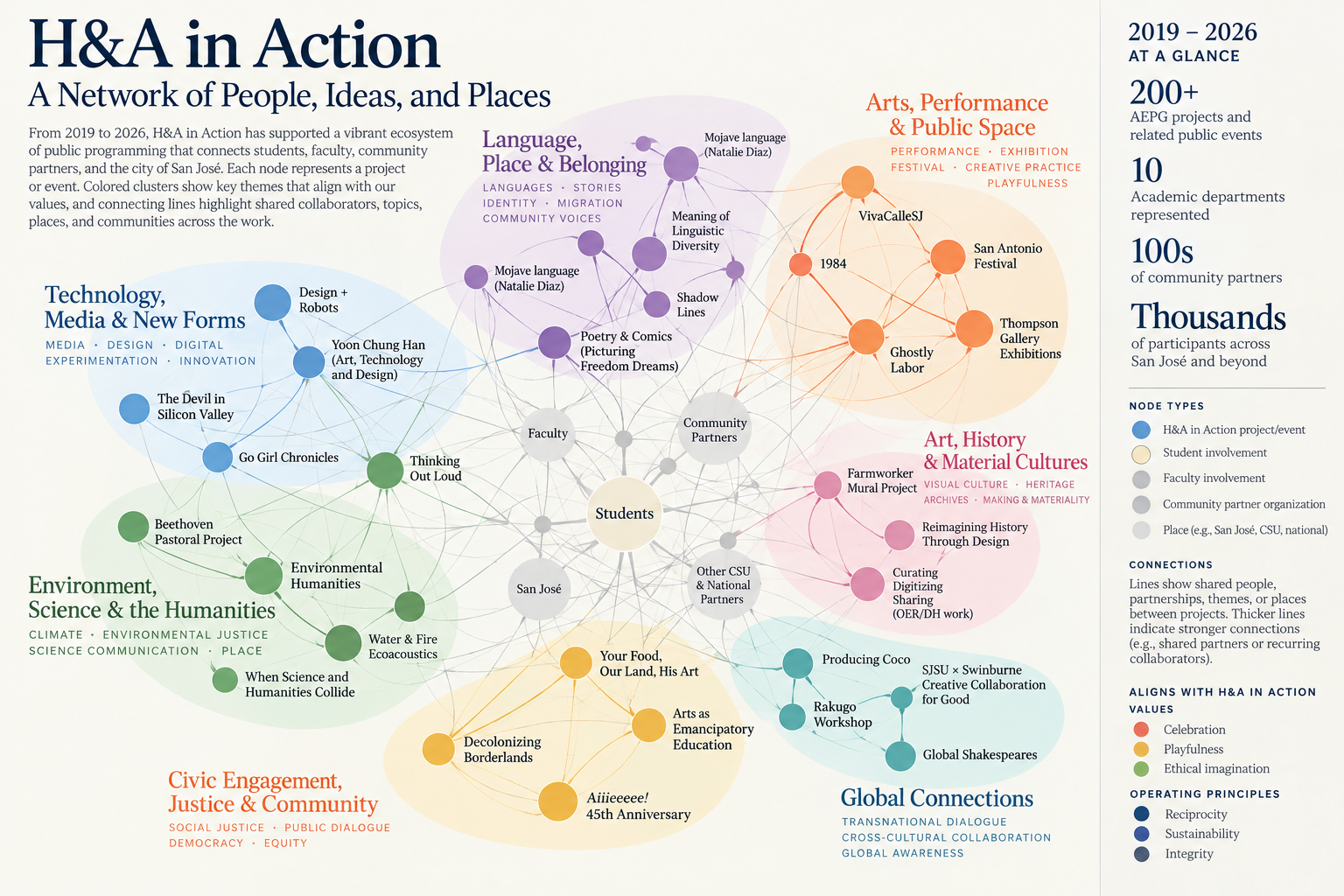
Taken together, these Stories of Engagement show the increasingly interconnected ecosystem that developed around AEPG. A project might begin with a novel, a choral work, a film, a play, a dance performance, a comics workshop, an original composition, or a community festival, but its educational life can extend far beyond the event itself. Students become artists, researchers, performers, filmmakers, designers, writers, and collaborators; faculty connect programming with curriculum and creative or scholarly inquiry; and community partners contribute knowledge, experience, and perspectives that change the work being produced.
The Stories of Engagement archive preserves this developing record of H&A students, faculty, artists, and community partners working together and provides a public history of how those relationships have expanded over time. Explore the Stories of Engagement archive
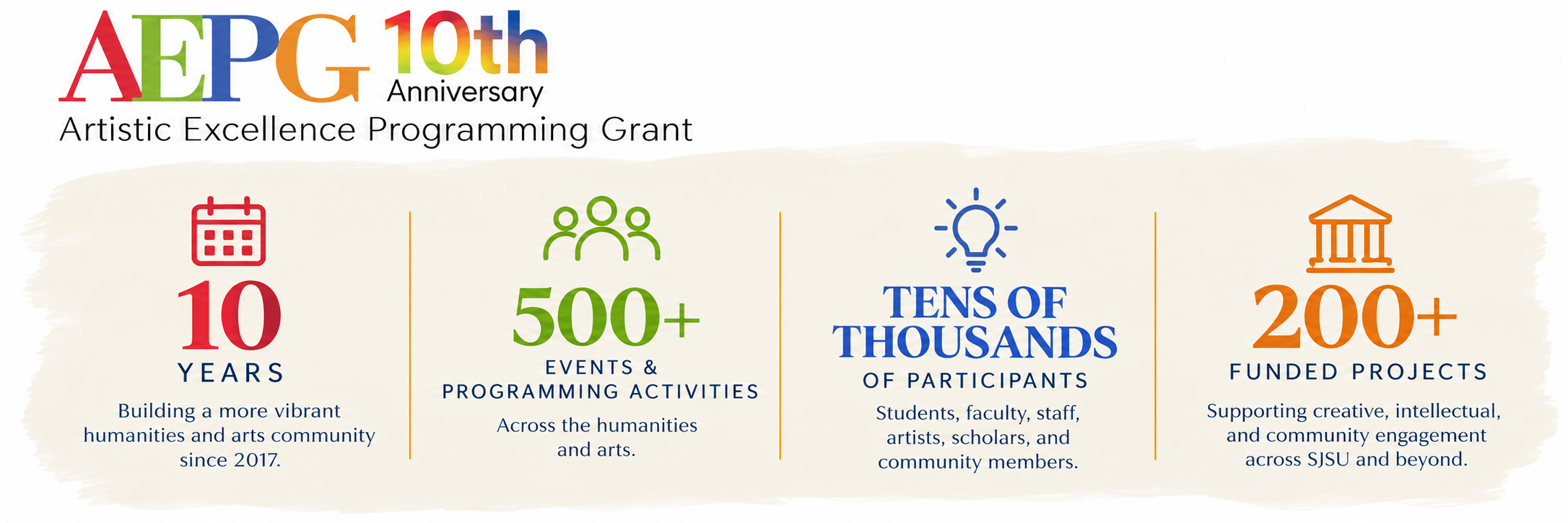
Impact: Rethinking What Success Looks Like
Over the past decade, AEPG has grown substantially in scale, but its understanding of success has also changed. Attendance tells us how far a program reaches. It does not tell us everything that happens when people participate: whether they encounter a new idea, contribute their own knowledge, make something, form a connection, or leave seeing a question differently.
That distinction matters because AEPG projects take many forms. A major performance may reach hundreds or thousands of people, while a small workshop may give students sustained access to an artist or scholar. A community collaboration may succeed because local expertise changes the direction of a project. A performance or exhibition may continue into the classroom through discussion, research, writing, design, or creative work. Each creates a different kind of impact.
As AEPG became part of H&A in Action, we began developing ways to understand those experiences more fully. The H&A in Action engagement survey asks participants why they attended, what they experienced, whether they would encourage others to participate, and what “big idea” they are taking away. It also asks participants to consider how their own identity or background shaped their experience. These questions give students and community members a role in defining the value of the programming themselves.
The responses have helped make forms of impact visible that attendance numbers alone cannot show. Between 2022–2023 and 2023–2024, the proportion of respondents reporting that they had been exposed to new ideas or programs rose from 40% to 62.4%. The survey also began reaching more people beyond SJSU: in 2023–2024, 185 non-SJSU community members identified themselves through the survey, compared with 58 the previous year.
What people choose to say about their experiences is just as revealing. Responses to the “big idea” question range across artistic practice, history, identity, language, technology, social questions, and personal reflection. By 2024–2025, community appeared much more prominently in these responses than it had in the previous two years, suggesting that participants were increasingly describing the value of programming in terms of relationships—with ideas, with other people, and with the communities surrounding SJSU.
The Stories of Engagement archive provides another way to see this impact. Together, the stories and participant responses document students working as performers, filmmakers, researchers, designers, writers, organizers, and collaborators; faculty connecting public programming to courses and creative inquiry; and community partners bringing their own expertise into the work. They preserve the experiences behind the numbers.
This has led AEPG toward a broader definition of artistic excellence and program success. Quality remains essential, and reach remains important. But success also includes the experience created around the work: the questions it opens, the participation it invites, the perspectives it brings together, and the relationships that continue beyond a single event.
For AEPG, impact is both reach and depth: who we bring together, what becomes possible while they are together, and what they carry forward afterward.
From Programs to an Ecosystem
Over time, these projects have created relationships that extend beyond individual events. Courses connect to performances; faculty collaborate across disciplines; students move between classrooms and public programming; community partners bring expertise into projects; and one collaboration can generate another. Viewed together, AEPG is less a collection of separate events than a network of people, ideas, practices, and relationships.
Where AEPG Is Going: Sustaining Experiential Learning
Ten years of AEPG represent more than the longevity of a grant program. Since Fall 2017, the College has sustained a shared pool of resources and a College-wide infrastructure dedicated to creating significant educational experiences through the humanities and arts. From its beginning, AEPG funding was intended to enrich students’ classroom and educational experiences, with student impact, curricular connection, and educational value built into the program’s review criteria.
A decade of sustained support has allowed that idea to develop. Students encounter the humanities and arts not only as subjects to study, but as living practices: something performed, made, researched, designed, translated, debated, interpreted, questioned, and shared. They work with professional artists and scholars, create films and exhibitions, perform new and established works, conduct research, develop public-facing projects, contribute to community collaborations, and bring what they learn in their courses into settings where that knowledge has consequences.
This is one of AEPG’s most important contributions to experiential learning. The experience does not necessarily begin when an audience arrives or end when an event concludes. It can begin in a classroom, rehearsal room, studio, archive, or conversation with a community partner. Students may help make the work that eventually becomes public; encounter it through coursework; contribute their own knowledge and perspectives; or carry questions generated by the experience back into another course, creative practice, or community.
AEPG’s long history has also demonstrated that the public and the university are not separate worlds. SJSU students themselves come from the communities surrounding the university, while artists, cultural organizations, local experts, alumni, and community partners regularly contribute knowledge to the educational experiences AEPG supports. Public programming creates occasions for those forms of knowledge to meet. Faculty scholarship and creative practice enter public life, community expertise enters student learning, and students participate in producing and interpreting knowledge rather than simply receiving it.
That model has become increasingly relevant as experiential learning takes on greater importance across higher education and the California State University. AEPG gives the College an existing foundation from which to deepen that work: sustained funding, faculty experience, community relationships, curricular connections, public venues, and a decade of evidence about how students and audiences engage with humanities and arts programming.
The next phase of AEPG will build deliberately on that foundation. Projects will be encouraged to think more carefully about what participants will actually experience, how students will engage with the work, what collaborators and communities contribute, and how a public program connects to learning before and after the event itself. The grant process will increasingly ask applicants to make those relationships visible so that resources support projects with both artistic or intellectual strength and meaningful opportunities for participation.
AEPG’s next decade therefore begins with an advantage that cannot be created quickly: ten years of relationships, practices, experimentation, and institutional knowledge. The opportunity now is to use that foundation to deepen experiential learning across the College—to create more occasions in which students learn through making, interpreting, collaborating, and participating in the intellectual, creative, and public life of the communities around them.
Reports & Data
AEPG’s development has been documented through annual reports, award records, event tracking, participant surveys, and the Stories of Engagement archive. Together, these materials provide a record of how the initiative has grown, how participation has changed, and how the College has continued to refine its understanding of impact.
Explore AEPG and H&A in Action reports and publications
-Katherine D. Harris
Executive Director of Strategic Initiatives
Oct. 10, 2026