Facilities, Computing and Software
Computing, visualization, robotics and simulation resources for digital twin development.
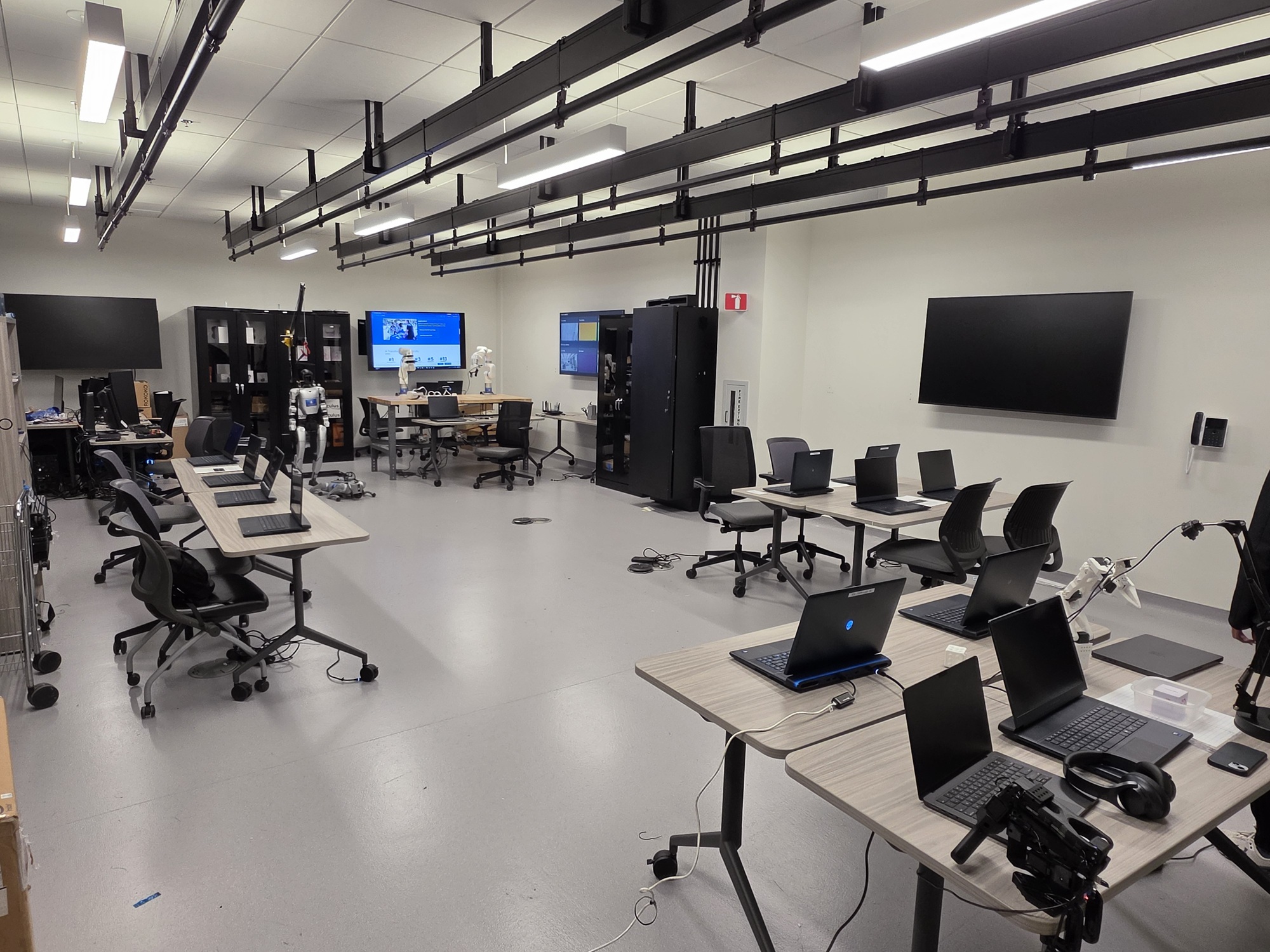
The lab combines GPU computing, mobile workstations, large-format displays, robotic
platforms and immersive technology.
Facilities Overview
The lab is designed as a flexible environment where users can move between modeling, simulation, data analysis, visualization and physical-system evaluation.
2 |
20 |
3 |
| GPU-enabled servers |
Alienware laptops |
Core NVIDIA software platforms |
Computing Infrastructure
The lab is equipped with two GPU-enabled Dell servers and 20 Alienware laptops. Together, these systems provide the computing capacity needed to develop, simulate, train and evaluate data-intensive digital twin and AI applications.
The mobile workstation layout supports individual work, small-group collaboration, demonstrations and reconfiguration for project-based courses and research activities.
Installed Software
- NVIDIA Omniverse Kit SDK v110.1.2
- USD Composer, built with Kit SDK v110.1.2
- NVIDIA Isaac Sim v6.0.1
Robotics and Immersive Systems
The lab includes robotic platforms, collaborative robotic arms, cameras, virtual-reality equipment, and large displays that allow users to compare physical systems with their simulated counterparts. These resources support simulation-first development, human-in-the-loop studies, perception research and sim-to-real evaluation.
Core Capabilities
- Interactive 3D modeling and visualization using USD-based workflows.
- GPU-accelerated simulation for robotics and physical AI.
- Synthetic image, depth, and segmentation data generation.
- Development of data pipelines that connect physical and virtual systems.
- Collaborative review of simulations, experiments and project demonstrations.
Page Highlights
Workstation Area
Flexible tables and mobile computing support courses, workshops and
team-based projects.
Robotics Area
Physical systems can be evaluated alongside simulated models and control workflows.
Visualization
Large displays support demonstrations, shared analysis, and review of digital environments.
Immersive Interaction
VR tools support human-in-the-loop interaction with simulated systems and environments.