Research and Projects
Digital twin research spanning simulation, data integration, robotics and physical AI.
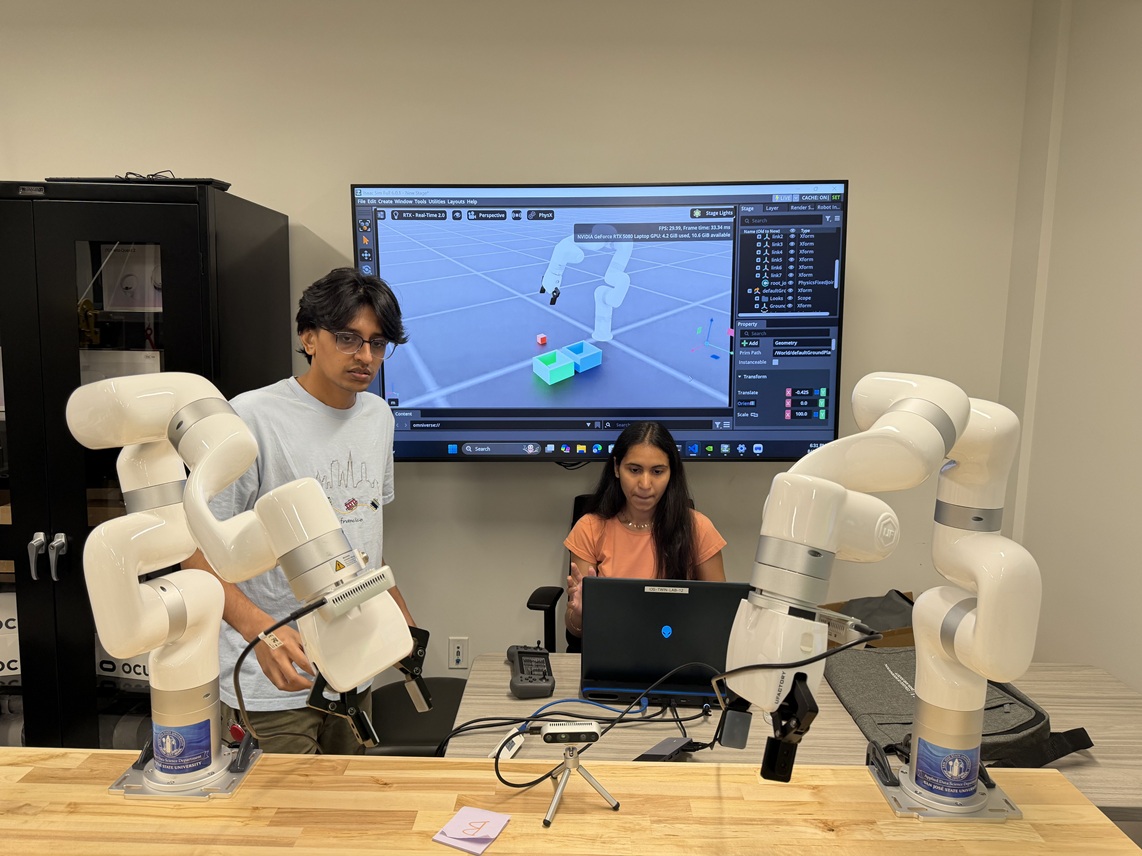
Physical robotic arms and their simulated counterparts support sim-to-real research and evaluation.
Research Focus
Research in the Digital Twin Lab centers on the relationship between a physical system and its computational representation: how the model is built, how it is connected to data, how accurately it represents behavior, and how it can support prediction, experimentation, and decisions.
Core Research Themes
- Digital twin architectures, synchronization, lifecycle management, model fidelity and digital threads.
- Physics-based, data-driven and hybrid models, including surrogate and reduced-order models.
- Real-time data integration, monitoring, anomaly detection and predictive maintenance.
- Human-in-the-loop twins and decision-support systems for exploring scenarios and recommendations.
- AI agents and natural-language interfaces that can query, interpret or act within digital twin environments.
- Robotics and physical AI simulation, including reinforcement learning, imitation learning and motion planning.
- Synthetic data generation for perception and multimodal AI, especially for rare or hazardous scenarios.
- Validation, uncertainty, explainability, interoperability, safety and failure analysis.
Simulation-First Robot Learning
Training directly on physical hardware can be slow, expensive, and unsafe. The lab supports a simulation-first approach in which robot policies are developed and evaluated in Isaac Sim and Isaac Lab before they are transferred to physical hardware. Domain randomization can vary lighting, textures, friction, mass, and sensor noise to improve robustness.
Sim-to-Real Transfer and Evaluation
Because the lab includes both simulation tools and physical robotic systems, students and researchers can run the complete loop: train in simulation, evaluate on hardware, measure where performance changes and use those differences to improve the model or policy.
Robot and World Foundation Models
The lab can support investigation of vision-language-action models, robot foundation models, and world-model approaches that generate physically plausible environments and interaction data. These methods are relevant to generalist robot behavior, scenario generation, synthetic data creation, and evaluation across tasks and robot platforms.
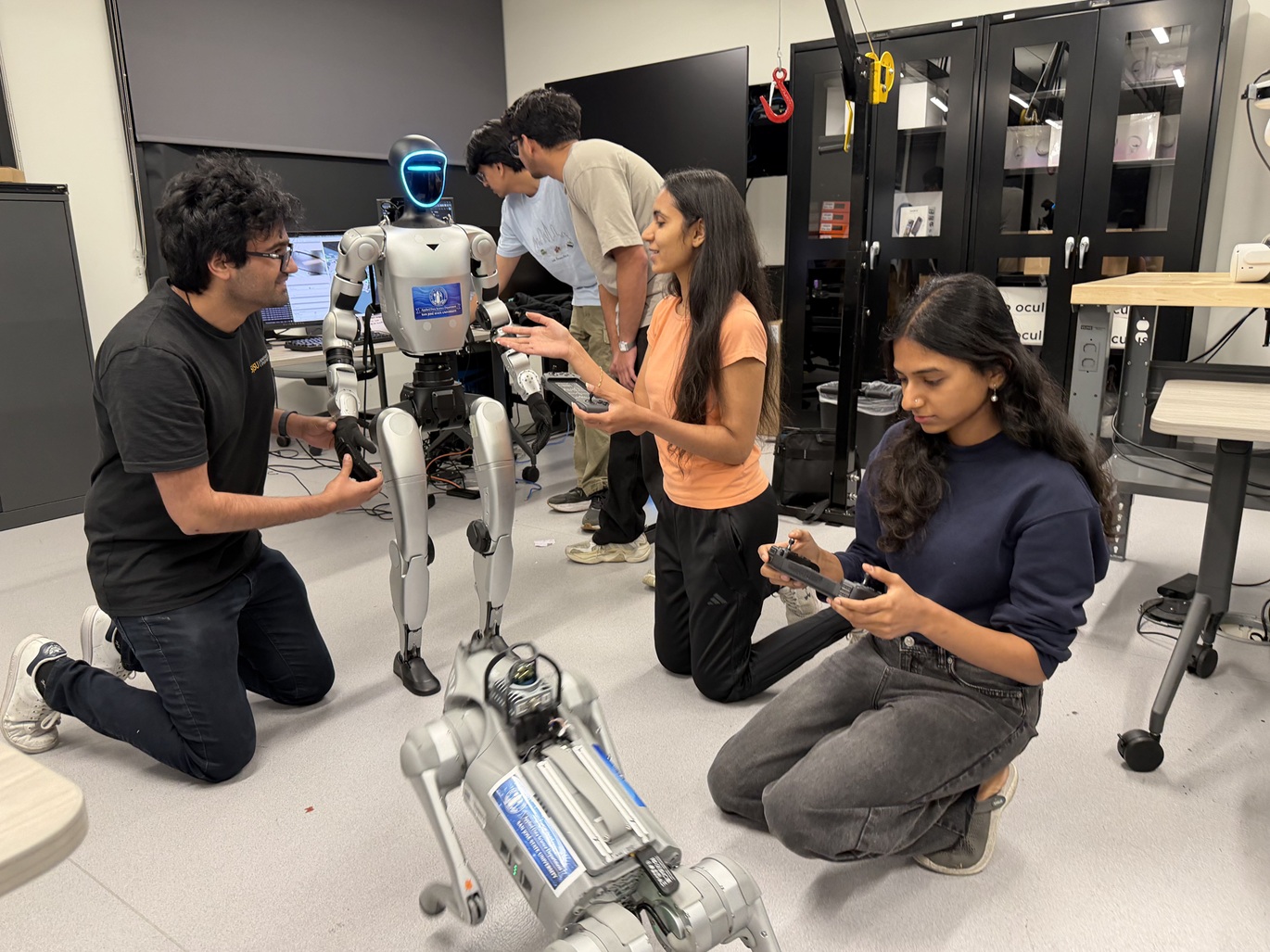
Collaborative evaluation of embodied AI and robotic systems in the Digital Twin Lab.